When Professor Simon Ortuanya took the oath of office on 11 August 2025 as the 16th Vice Chancellor of the University of Nigeria, Nsukka, the institution stood at a difficult crossroads. Years of infrastructural decline, policy drift, weakened governance, and frayed community relations had pushed the country’s premier university to the edge of institutional fatigue. One hundred days later, the story has changed dramatically.
Though the Vice Chancellor marked no special ceremony on 19 November, strongly insisting instead on “quiet reflection and stock-taking,” the period has already produced achievements more often associated with more than a full year in office. His early steps, taken with what many staff describe as “purposeful urgency,” set the tone for a bold revival.

One of the trunks of the ambitious 4.5KM road projects the current VC saw to their completion.

His first major charge was rebuilding the physical heart of the campus. Within his first week, Ortuanya toured facilities and launched an aggressive infrastructure recovery programme. Major internal roads like Elias Avenue, Zik’s Drive, Chitis/Alumni Road, Main Gate Road, and the VC Office Road, were rehabilitated. The moribund UNN Filling Station, dormant for decades, now operates again with four newly installed pumps. Renovation of student hostels is ongoing, while foundations for three new hostel blocks will soon be laid.
The long-abandoned Senate Building, stuck at the piling stage for years, has roared back to life. Construction has resumed, with the ten-storey structure already at the foundation stage. The VC’s Lodge has also been restored, and a dedicated mini-power grid is earmarked exclusively for the university library.
The Vice Chancellor is also revamping the academics and research capacity of the institution. Determined to restore UNN’s academic edge, Professor Ortuanya established two new centres within his first 100 days. These are the Michael Okpara Centre for Leadership, designed to strengthen leadership and character development training, and the Electric Vehicle Development Centre, signalling the university’s emergence in future-ready technological research.
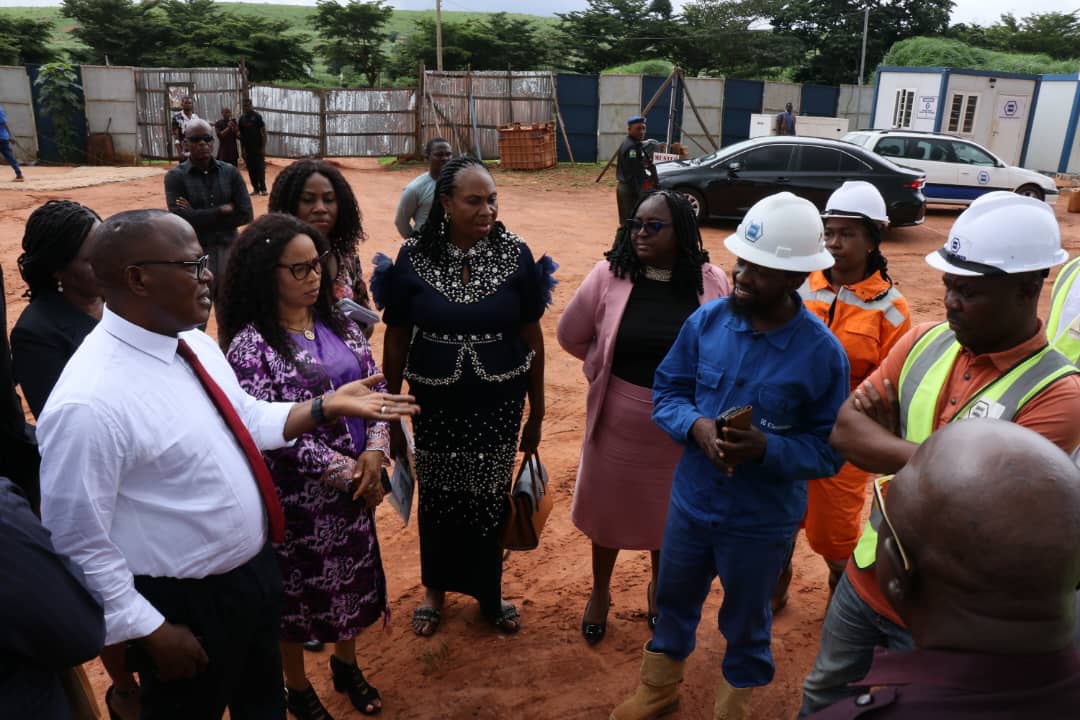
The VC interacting with the contractor handling the Senate Building
Meanwhile, staff and student welfare never escaped his attention within the same period. One of the earliest directives of the VC was the completion of outstanding staff evaluations and promotions. Hundreds of workers across junior and senior cadres have since been elevated to their proper ranks from the stagnation they had bitterly endured for years.

The VC with members of the SUG
Housing and student accommodation challenges prompted the creation of a new Housing and Accommodation Directorate, dedicated exclusively to addressing the university’s long-standing residential problems. Community relations have also been strengthened through a dedicated Community Relations Directorate for Nsukka, Enugu, and Ituku-Ozalla campuses.
For students, the reactivation of suspended union activities has restored internal democracy and campus vibrancy.

UNN filling station abandoned in ruins for years, now back to life, courtesy of Prof. Ortuanya’s innovative leadership

Before the new administration, the university struggled under weak governance frameworks. Ortuanya moved quickly, establishing robust new policy structures for Public-Private Partnership, Communications, Research and Update, ICT, and Whistleblowing. Each has a standing committee to ensure operational ease and compliance.
On security, the Vice Chancellor worked hard to within the same period have a change of narrative on campus security by overhauling their operations beginning with the appointment of a new campus security chief. This was followed by a staff audit, and the procurement of modern equipment, including patrol motorcycles showcased during a recent high-level UNN Security Summit attended by senior state security officials.

Completed road projects along the convocation avenue, at Nsukka Campus of the University


Perhaps the most transformative stride has been his campaign to reposition UNN globally under its Global Engagement and Institutional Visibility Initiatives. To these ends, the university hosted a delegation from the Swedish Embassy to explore academic cooperation, with several programmes set for rollout next year.
In Canada, Ortuanya met the President of the University of Waterloo, Prof. Vivek Goel, leading to an MoU covering interdisciplinary research, cooperative education, and institutional capacity building.
Between 19 and 25 October 2025, he led a delegation to Taiwan, engaging with leading institutions including National Chengchi University, Ming Chuan University, Tamkang University, Taiwan’s Ministries of Foreign Affairs and Education, and the Taiwan African Business Association.
Indeed the Vice Chancellor has not relented these past one hundred years in pursuing his dreams for the university. His persistent engagement with TETFund, where he personally visited repeatedly for weeks, yielded approvals, procurement clearances, and mobilization for key projects.

Prof. Ortuanya, with the interim President of University of Michigan Domenico Grasso, in Michigan, USA
Some of these projects that would soon be built are: a faculty block for the College of Medicine, Ituku-Ozalla; a 40-room hostel for Nursing students; a 40-room hostel for Pharmacy students; a laboratory building that would be fully equipped and furnished; complete supply and installation of laboratory equipment for the College of Medicine.
Observers have described Ortuanya’s first 100 days as a demonstration of what determined leadership can achieve. His approach, driven by passion, innovation, courage, and deliberate reform, has rekindled institutional confidence and redirected the University of Nigeria toward the global relevance it once enjoyed.
For the premier university, long in search of a renaissance, the Ortuanya administration’s first 100 days signal not just progress, but possibility. And as the VC himself insists, this is “only the beginning of the beginning.”
Dr. Eze writes from Enugu.