
The SAVED AMLSN Movement has raised serious professional and statutory concerns over the National Agency for Food and Drug Administration and Control (NAFDAC) press release of August 13, 2026, titled “NAFDAC Strengthens Regulatory Oversight of Blood and Blood Products to Safeguard Public Health.”
In a conference rebuttal issued in response to the NAFDAC statement, the movement said it supports every genuine effort to improve the safety, quality, availability and efficacy of blood and blood products in Nigeria, stressing that patient safety should remain the common objective of all health regulatory institutions.
However, the group rejected what it described as any interpretation or implementation of the NAFDAC pronouncement that could amount to exclusive or overriding regulatory control over professional Medical Laboratory Science practice, blood transfusion science, Medical Laboratory Scientists or medical laboratory facilities.
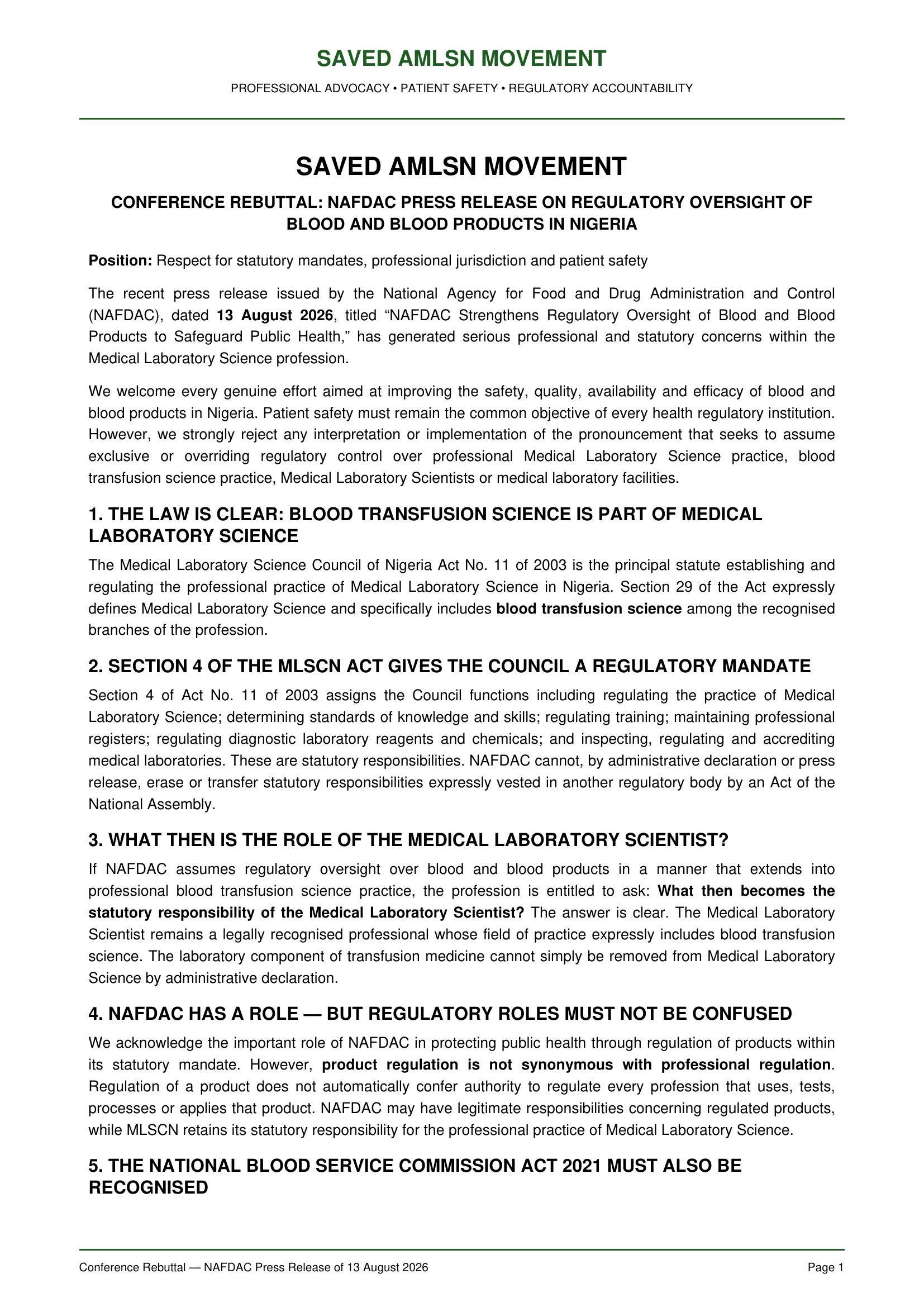
Blood transfusion science is part of Medical Laboratory Science, group insists
At the centre of the rebuttal is the Medical Laboratory Science Council of Nigeria (MLSCN) Act No. 11 of 2003.
According to the SAVED AMLSN Movement, Section 29 of the Act expressly defines Medical Laboratory Science and includes blood transfusion science among the recognised branches of the profession.
The movement argued that this statutory provision establishes the professional place of Medical Laboratory Scientists within blood transfusion science and that the laboratory component of transfusion medicine cannot be removed from the profession through an administrative declaration.
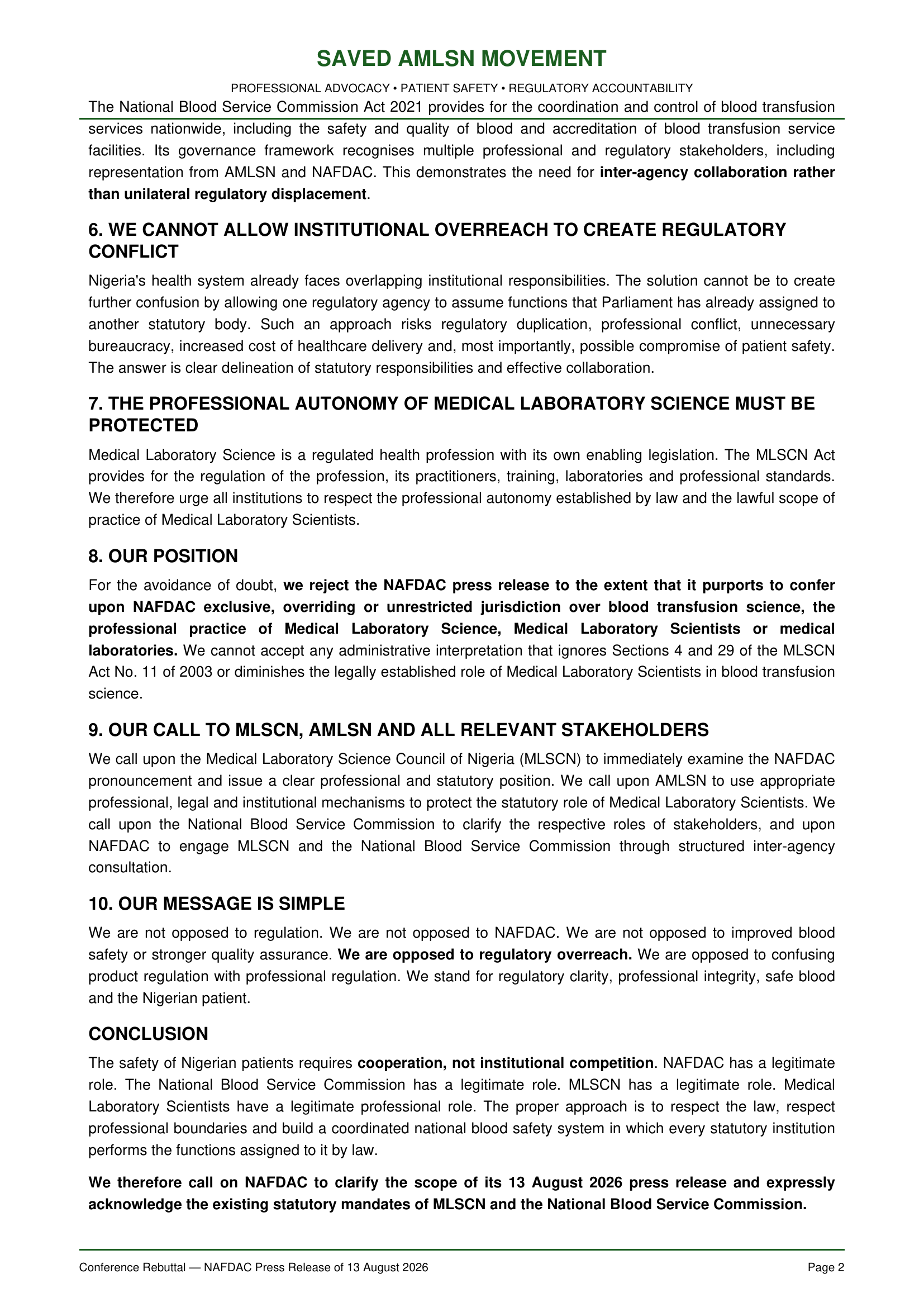
MLSCN’s statutory mandate
The group also pointed to Section 4 of the MLSCN Act, which it said assigns the Council responsibilities including regulating the practice of Medical Laboratory Science, determining standards of knowledge and skills, regulating training, maintaining professional registers, regulating diagnostic laboratory reagents and chemicals, and inspecting, regulating and accrediting medical laboratories.
The movement maintained that these responsibilities are statutory and cannot be erased or transferred by an administrative declaration or press release.
It consequently questioned what would become of the statutory responsibilities of Medical Laboratory Scientists if regulatory oversight of blood and blood products were interpreted to extend into professional blood transfusion science practice.
NAFDAC role acknowledged
Despite its objections, the SAVED AMLSN Movement said it recognises NAFDAC’s important role in protecting public health through the regulation of products within its statutory mandate.
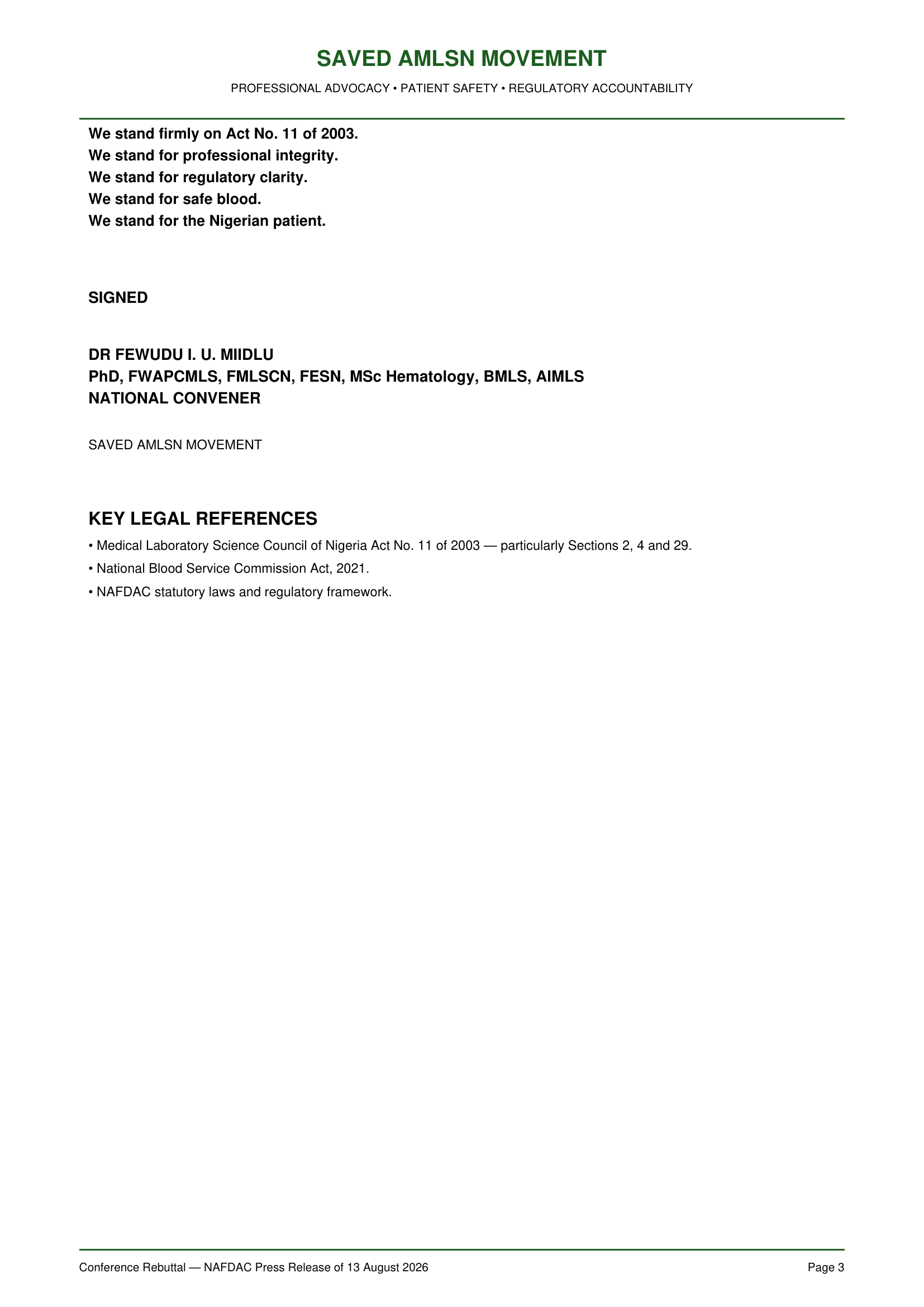
The movement, however, stressed that product regulation should not be confused with professional regulation.
It argued that the regulation of a product does not automatically confer authority to regulate every profession that uses, tests, processes or applies that product.
According to the group, NAFDAC may have legitimate responsibilities concerning regulated products, while MLSCN retains its statutory responsibility for the professional practice of Medical Laboratory Science.
National Blood Service Commission also has a role
The rebuttal further drew attention to the National Blood Service Commission Act, 2021, which the movement said provides for the coordination and control of blood transfusion services nationwide, including the safety and quality of blood and accreditation of blood transfusion service facilities.
It noted that the governance framework recognises multiple professional and regulatory stakeholders, including representation from the Association of Medical Laboratory Scientists of Nigeria (AMLSN) and NAFDAC.
The movement said this framework underscores the need for inter-agency collaboration rather than what it described as unilateral regulatory displacement.
Warning against institutional conflict
The SAVED AMLSN Movement warned that overlapping institutional responsibilities within Nigeria’s health system could create regulatory duplication, professional conflict, unnecessary bureaucracy and increased healthcare costs.
More importantly, it argued that regulatory confusion could potentially compromise patient safety.
The group therefore called for a clear delineation of statutory responsibilities and stronger collaboration among the relevant institutions.
Call for protection of professional autonomy
The movement also called for the protection of the professional autonomy of Medical Laboratory Science, noting that the profession operates under its own enabling legislation.
It urged relevant institutions to respect the lawful scope of practice of Medical Laboratory Scientists and the professional standards established under the MLSCN Act.
Calls for clarification and consultation
The SAVED AMLSN Movement called on the Medical Laboratory Science Council of Nigeria to immediately examine the NAFDAC pronouncement and issue a clear professional and statutory position.
It also urged AMLSN to employ appropriate professional, legal and institutional mechanisms to protect the statutory role of Medical Laboratory Scientists.
Similarly, the National Blood Service Commission was asked to clarify the respective roles of stakeholders, while NAFDAC was urged to engage MLSCN and the National Blood Service Commission through structured inter-agency consultation.
“We are not opposed to regulation”
In a central message of the rebuttal, the movement emphasised that its position should not be interpreted as opposition to regulation or to NAFDAC.
“We are not opposed to regulation. We are not opposed to NAFDAC. We are not opposed to improved blood safety or stronger quality assurance,” the movement stated, while adding that it opposes what it characterises as regulatory overreach and the conflation of product regulation with professional regulation.
The movement said it stands for regulatory clarity, professional integrity, safe blood and the Nigerian patient.
Appeal for cooperation
Concluding the statement, the SAVED AMLSN Movement said the safety of Nigerian patients requires cooperation rather than institutional competition.
It acknowledged that NAFDAC, the National Blood Service Commission, MLSCN and Medical Laboratory Scientists each have legitimate roles within the national blood safety framework.
The group therefore called for respect for existing laws and professional boundaries, alongside the development of a coordinated national blood safety system in which each statutory institution performs the functions assigned to it by law.
It further called on NAFDAC to clarify the scope of its August 13, 2026 press release and expressly acknowledge the existing statutory mandates of MLSCN and the National Blood Service Commission.
The statement was signed by Dr. Fewudu.
The movement anchored its position on the Medical Laboratory Science Council of Nigeria Act No. 11 of 2003, particularly Sections 2, 4 and 29; the National Blood Service Commission Act, 2021; and NAFDAC’s statutory laws and regulatory framework.