In a major milestone for Medical education and professional development in Nigeria, the Federal Government has officially approved the Doctor of Medical Laboratory Science (MLSD) degree as a recognized academic programme in Nigerian universities. The announcement was confirmed alongside the introduction of eleven other new academic courses designed to address emerging global trends and improve graduate employability.
The approval of the MLSD programme follows a high-level advocacy visit by the leadership of the Association of Medical Laboratory Scientists of Nigeria (AMLSN) to the National Universities Commission (NUC) earlier this year. On Tuesday, February 25, 2025, the 15th National President of AMLSN, Dr. Casmir Ifeanyi, led a delegation of prominent members of the profession to meet with the Executive Secretary of the NUC, Professor Abdullahi Yusuf Ribadu, at his office in Abuja.

Dr. Casmir Ifeanyi addressing the Executive Secretary of NUC, during the visit
Members of the delegation included Prof. N.S. Etukudoh, Prof. Chukwu O. Chukwu, Dr. Okechukwu Ironkwe, MLS Livinus Ibang, MLS Aleke Chukwudi, and MLS Oby Benson. During the visit, the Dr. Casmir made a four-point advocacy request, with the central demand being the formal upgrading of the Bachelor of Medical Laboratory Science (BMLS) degree to a Doctor of Medical Laboratory Science (MLSD) degree.
According to information made available to the press, Professor Ribadu approved the immediate appointment of a Desk Officer for Medical Laboratory Science during the meeting and gave his commitment to fast-track the process for the approval of the MLSD programme. That promise has now been fulfilled, with the announcement of the approval two months later.

A group photograph with the Delegation and the Executive Secretary
The MLSD degree is expected to elevate the academic and professional standing of Medical Laboratory Scientists in Nigeria and bring their training in line with international best practices. It is anticipated that the programme will focus on advanced diagnostic methods, leadership, research, and innovation in Medical Laboratory Science.
The approval of the MLSD programme comes alongside the introduction of eleven other new degree courses in Nigerian universities. These include: Artificial Intelligence, Classical Christian Education, Community Health Science, Cooperative Economics and Management Studies, Geomatics Engineering, Intelligence and Security Studies, Parasitology and Entomology, Sports Management, Telecommunication Science, Water Sanitation and Hygiene, Islamic Economics and Finance.
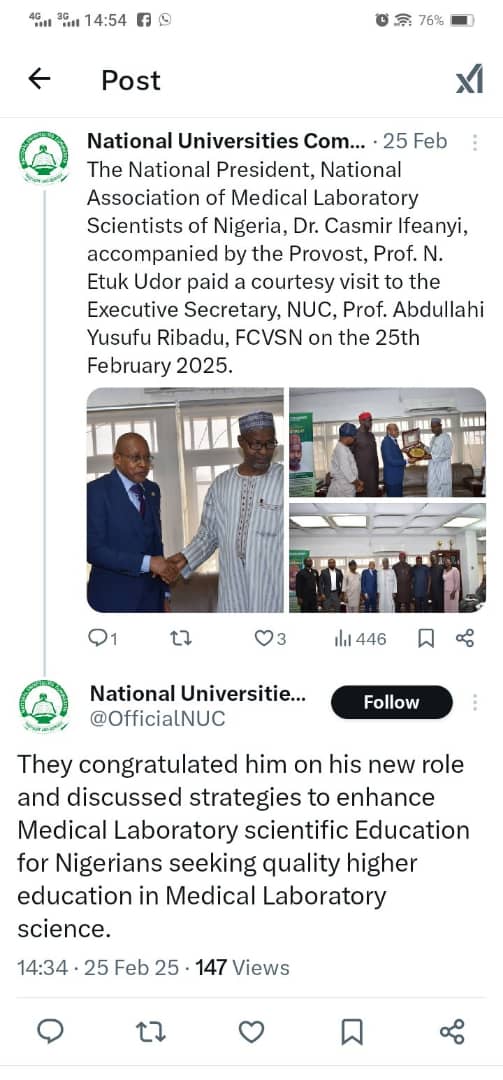
A screenshot of a post made by NUC in its official X (formerly Tweeter) immediately after the visit on February 25
These courses are part of a broader national strategy to align university curricula with evolving global academic and industry demands. The NUC, which oversees academic programme development and regulation in Nigerian Universities, is expected to guide the implementation of these new offerings across institutions nationwide.
The expansion of University programmes reflects the Federal Government’s ongoing commitment to reforming the country’s tertiary education sector to produce a workforce that is responsive to the challenges and opportunities of the 21st century.
Reacting to the development, the National President of AMLSN, Dr. Casmir Ifeanyi, in a memo circulated to members of the Association, described the approval as “a new dawn in the academic and professional advancement of Medical Laboratory Science in Nigeria.” He thanked stakeholders including the Board of Trustees, the Young Medical Laboratory Scientists Forum (YMLSF), the Association of Female Medical Laboratory Scientists (AFMLS), and the Association of University Academic Medical Laboratory Scientists (AUAMLS) for their support throughout the process.

He also expressed appreciation to the Executive Secretary of the NUC, Professor Ribadu, for his responsiveness and commitment to the growth of the Medical Laboratory Professionals in Nigeria.
The NUC is expected to issue further guidelines on the structure, curriculum, and institutional rollout of the MLSD degree in the coming weeks. Once operational, the programme will position Nigerian-trained Medical Laboratory Scientists for enhanced roles in research, clinical diagnostics, and global health systems.
This development is seen by many stakeholders as a significant step in addressing the need for specialized and advanced healthcare professionals in Nigeria, as well as improving the global competitiveness of Nigeria’s medical education system.
Damilola Ogunsoya, in Abuja.