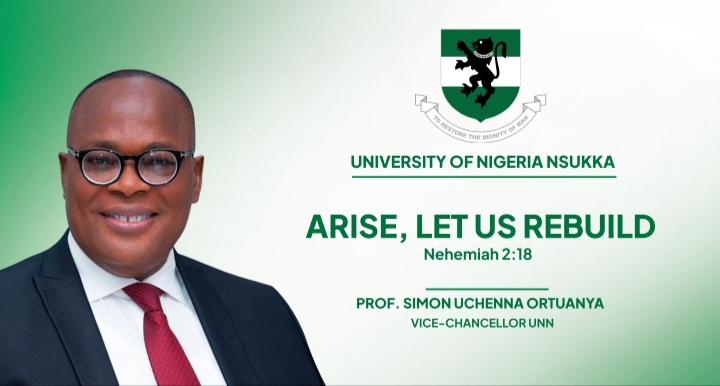
At about 05:39 PM local time, on August 03 2025, an imaginary chimney from the hallowed Senate Chambers of the University of Nigeria, Nsukka (UNN), emitted a white smoke of electoral success. Keen observers and admirers of the University, filled with suspense hissed a sigh of relief. It was a day that the School’s electoral College stitched a new thread into the fabric of the Institution’s history. Through a tightly contested election, Prof. Simon Uchenna Ortuanya emerged as the 16th Vice Chancellor of that great Citadel of Learning. Ordinarily, his victory should have been just another change of baton. But beyond that, it was a landmark, for he is the first indigenous son of Nsukka Zone (Enugu North Senatorial Zone) to ascend the revered seat of the University’s Chief Executive.
Jubilation was the natural response. From his hometown of Ohodo, in Igbo Etiti LGA of Enugu State, to the far corners of the alumni diaspora, voices rose in celebration. Gratitude flowed towards His Excellency Dr. Peter Ndubuisi Mbah, Executive Governor of Enugu State, and President Bola Ahmed Tinubu, GCFR (Visitor of the Institution), whose respective roles made this appointment possible. Yet, in the midst of the festivities, Prof. Ortuanya’s election was not a call to rest on laurels, it was a rallying cry to action.
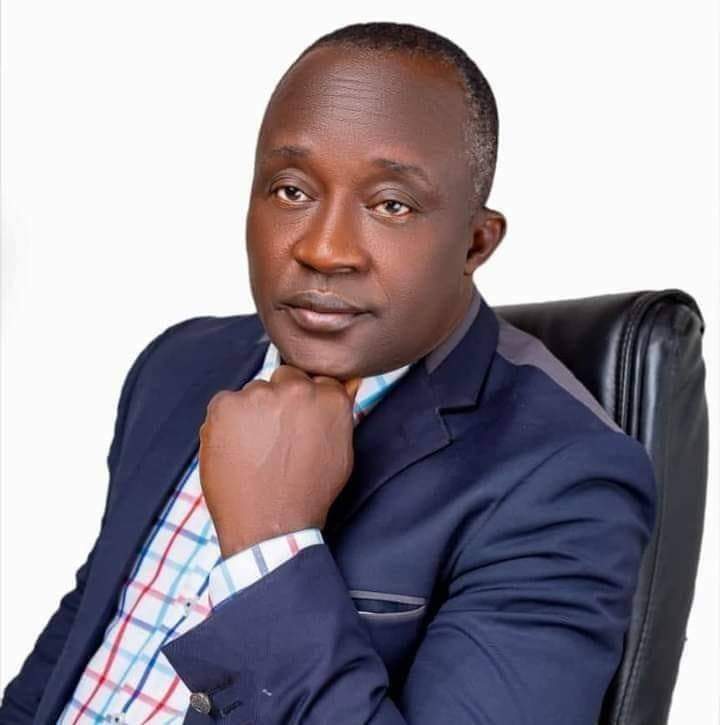
Onyekachi C. Ugwu
The Author
He knew it. He seemingly came prepared. This morning, as he stepped out of his house to resume duty officially, he sent out a soul-touching appeal to the University Community and the world at large. In his first official address to the University community, he anchored his vision on the biblical charge from Nehemiah 2:18: “Arise, let us rebuild.”
It was a short sentence, which sinewed his inaugural speech, but it is bursting with urgency and vision. Originally it was Nehemiah’s cry to the exiles of Jerusalem to restore their broken walls. Now, it is Prof. Ortuanya’s cry to all who love UNN to restore and elevate her standing in scholarship, innovation, as well as moral leadership.
Great institutions are never built by solitary genius; they are built by the concert of many hands and minds. Aristotle once wrote: “The whole is greater than the sum of its parts.”
In the same vein, Prof. Ortuanya’s challenge is an invitation to synergy, the type that transforms a collective dream into palpable achievement. Amidst mounting contemporary challenges such as funding constraints and global competitiveness, the task before UNN of today is both fearful, as it is noble.
To arise is to refuse complacency; to rebuild is to recognize that the glory of yesterday must be surpassed by the labor of today. In all honesty, this demands more than administrative reforms, it requires a cultural renaissance within the University community.
Ortuanya’s choice of Nehemiah’s words is instructive. Nehemiah did not merely lament the ruins of Jerusalem; he mobilized the people, planned meticulously, and rebuilt against all odds. In theological terms, this was not just an act of construction, it was, indeed an act of worship. The walls were more than stone; they were symbols of dignity and identity, as well as divine purpose.
Juxtaposed, the University of Nigeria is not just bricks and lecture halls, it is the living altar of Nigeria’s intellectual, moral, and cultural heritage. To rebuild her is to honor the vision of her founding fathers, to restore her dignity in the comity of world-class institutions, and to prepare a table for generations yet unborn.
In the ancient times, the common motto of Monks was “laborare est orare” (to work is to pray). This means that they pray while the work is done by perhaps, Providence. But, as the world evolved, they too followed suit, and so was their motto. Today, their slogan is “laborare et orare” (you work as you pray). Even St. Augustine of Hippo reminded us to “pray as though everything depended on God. Work as though everything depended on you.” This clarion call to “arise” is a summons to both spiritual and practical commitment.
Prof. Ortuanya’s pledge to “dare to break new frontiers” carries an implicit promise of bold reforms. History reminds us that every renaissance in human society began when leaders and followers refused to be prisoners of the status quo. Marcus Aurelius, the Stoic philosopher-king, wrote: “The impediment to action advances action. What stands in the way becomes the way.”

Prof. Ortuanya, Vice Chancellor, University of Nigeria
In academia, obstacles such as resource scarcity, infrastructural decay, and bureaucratic inertia are not to be feared; they are to be transformed into stepping stones. The challenge is to make UNN a place where research output speaks globally, where innovations sprout from laboratories and studios, and where graduates are not just job seekers but problem solvers.
This is why I believed that the new VC’s message is not reserved for faculty and students alone. It extends to alumni, parents, government agencies, private sector partners, and indeed all men and women of goodwill. In the theology of rebuilding, the wall belongs to everyone.
The Apostle Paul’s exhortation to the Galatians, connotes with it thus: “Let us not become weary in doing good, for at the proper time we will reap a harvest if we do not give up.” (Gal. 6:9).
For UNN, this harvest could be a future where her graduates dominate in innovation, public leadership, global scholarship, and moral example.
The emblem of UNN bears a lion, standing fierce, regal, and unyielding. The roar of that lion must now be heard in the global academic arena, not as nostalgia for past glory, but as evidence of renewed vitality.
And in the spirit of Nehemiah, we must arise, not tomorrow, not later, but now.
An ancient African proverb says: “When the music changes, so does the dance.”
The music at UNN has changed. The dance must follow.
Arise, let us rebuild!
© Onyekachi C. Ugwu
August 2025.