“In politics, loyalty to truth is the rarest courage.” — adapted from Hannah Arendt
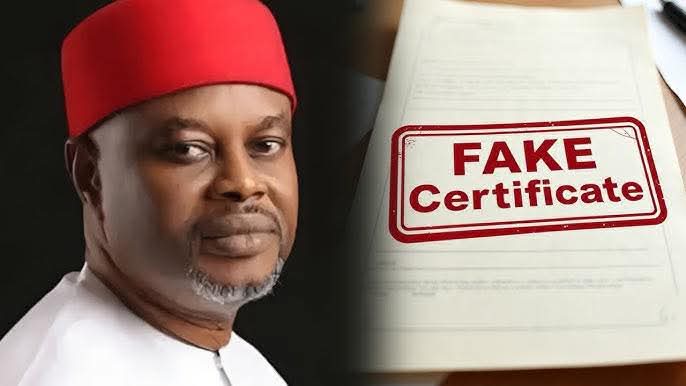
Public discourse in Enugu has lately been poisoned by an article written by one Chibuike Chime, which mistakes invective for argument and substitutes character assassination for introspection. Its target is Barrister Ugochukwu Agballah; its unstated purpose is absolution; an attempt to launder the moral burden of unanswered questions around former Minister, Hon. Uche Nnaji, by redirecting public anger toward a convenient scapegoat.
I am writing this rejoinder, not because Ugo Agballah is flawless, (no political actor is), but because truth deserves defence, especially when it becomes inconvenient.
In the uncelebrated article, Chibuike (or whatever name the writer hid under) accused Ugo Agballah of betrayal. But this is unacceptable, because to accuse Ugo Agballah of betrayal is to fundamentally misdiagnose what occurred. Betrayal presupposes mutual honesty. What we witnessed instead was a collapse of confidence rooted in non-disclosure of a matter that strikes at the heart of constitutional eligibility and public trust.
How did we get here?
The roots lie in the peculiar aftermath of the 2023 governorship election in Enugu, where Nnaji, the then APC candidate, finished a distant third with barely a few thousand votes, far behind Peter Ndubuisi Mbah and Chijioke Edoga.
Yet, by the alchemy of federal appointment, Nnaji’s electoral rejection was swiftly converted into ministerial elevation, and with it came an inflated sense of political centrality. From that moment, Uche made Enugu politics became less a contest of ideas and more a theatre of resentment. Rather than consolidate his new national responsibility in Abuja and contribute meaningfully to President Tinubu’s Renewed Hope agenda, Nnaji appeared to relocate his Ministry’s headquarters to Enugu, deploying digital foot soldiers to wage a relentless propaganda war against a sitting governor who was busy governing.
Matters came to a head when the PDP’s unresolved national crisis triggered realignments across the country, making Governor Peter Ndubuisi Mbah’s then possible defection to the APC not an anomaly but a political inevitability. In Nigeria’s party politics configuration, leadership of the party at the State level, gravitates, by convention and pragmatism, to the highest office holder in the State. The prospect of that displacement exposed the fragility of Nnaji’s claim to party supremacy. What followed was not ideological disagreement but political panic, leading to obstruction, tantrums, and an attempt to frustrate a governor’s entry into the party he himself professed loyalty to. Fear of displacement bred hostility; and hostility bred obstruction. It was in this climate of overreach and desperation that unresolved questions about credentials, long whispered but never responsibly addressed, returned with force. When concerned institutions spoke, and Uche’s documents failed to surface, the myth collapsed.
What followed was predictable: anger displaced accountability, allies were recast as traitors, and figures like Ugo Agballah became targets, not for deceit, but for surviving the implosion of an ambition that mistook federal appointment for popular mandate.
Uche Nnaji did not merely fail a political ally; he withheld a material truth from those who staked their credibility and reputations on his ambition. That is not a private oversight. It is a public wrong.
Politics, at its core, is fiduciary. When you ask people to defend you, you owe them the truth, especially when the issue goes to qualification for office. Edmund Burke warned long ago that “hypocrisy can afford to be magnificent in its promises, for never intending to go beyond promise, it costs nothing.” Silence, in this context, was not neutrality; it was deception by omission.
If we remove the noise, the proxy wars and the florid prose, one question remains stubbornly unanswered:
Did Uche Nnaji ever issue a clear, unambiguous public denial that his degree certificate was forged?
Not an attack on critics.
Not a lawsuit against enemies.
Not a press release blaming conspirators.
In a democracy governed by law, documents are not insults; they are answers. The refusal, or inability, of the University of Nigeria, Nsukka to release a straightforward transcript did not injure Ugo Agballah. It injured every supporter who defended Nnaji in good faith.
As the legal philosopher Lon Fuller observed, “The morality of law is violated not only when rules are unjust, but when clarity is deliberately withheld.”
Ugo Agballah’s real offence, it seems, is not betrayal but refusal to lie indefinitely.
While the political romance lasted, he was celebrated as strategic, brilliant, indispensable. When facts emerged that could not be wished away, he chose alignment with party leadership and institutional order rather than personal loyalty to a narrative under strain.
That is not treachery. That is political adulthood.
The article attacking him reveals more than it intends: a worldview in which loyalty is owed to individuals, not to truth; to ambition, not to law. But political parties are not monasteries, and leaders are not popes. They are accountable to rules.
Professor Simon Ortuanya’s role has been grotesquely misrepresented. A Vice-Chancellor is not a political actor; he is a custodian of records. His obligation is not to reputations but to archives.
Assuming, without conceding, that a degree certificate was tampered with, a larger legal puzzle arises: can a person simultaneously disclaim a university degree and still rely on an NYSC discharge certificate authenticated under a different identity?
NYSC is a statutory body. If it disowns a certificate, that is not politics; it is administrative fact. Nigeria has been here before. The Kemi Adeosun precedent remains instructive not because the cases are identical, but because the principle is immutable: eligibility founded on false documentation collapses retrospectively.
What is owed to Ugo Agballah, and others like Chukwunonye Okereke who defended blindly, is not abuse but apology.
Apology in this sense, is not surrender. It is restoration.
As Vaclav Havel once wrote, “Responsibility means accepting the consequences of one’s actions, not explaining them away.”
If Uche Nnaji had taken his allies into confidence early, explained, clarified, documented, no one would be speaking of betrayal today. Instead, supporters were left to defend shadows, only to discover that the ground beneath them was never solid.
This matter must not be swept under the carpet, nor should it be settled by online lynching. Forgery and perjury are constitutional issues. They demand due process, investigation, and, where necessary, prosecution.
The loudest danger to democracy is not accusation; it is selective silence.
Ugo Agballah did not burn a house. He stepped out of one already on fire.
History is unkind to those who confuse loyalty with obedience and courage with noise. In Enugu’s current political evolution under the watch of Gov. Mbah, the future will belong not to those who shout the loudest, but to those who choose institutions over idols and truth over convenience.
“A lie can travel halfway around the world while the truth is still putting on its shoes,” Mark Twain warned.
But the truth, when it arrives, does not ask for permission.
And neither should those who stand by it.
Ugada Nkemakolam is a public affairs commentator, and writes Amangwu Villa, Amokwe