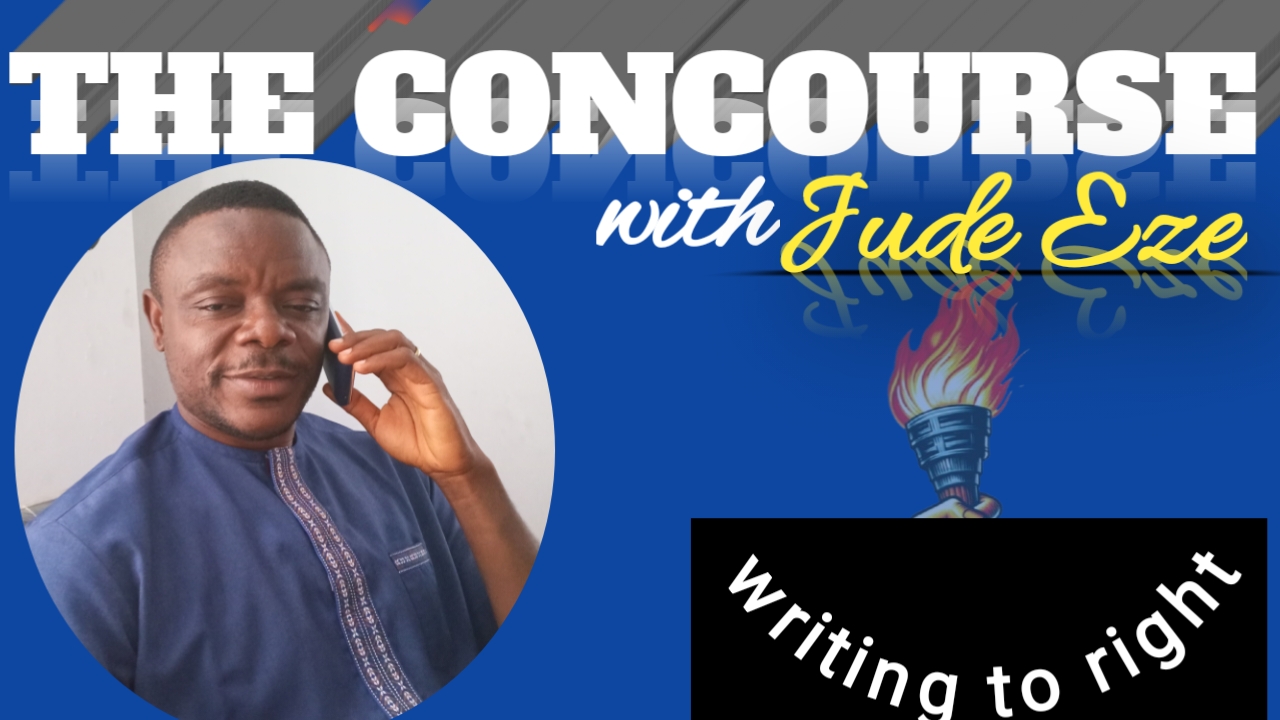
In today’s discourse, I crave your indulgence to take an unexpected turn and address an unseen concern.
For almost 8 years, most of my Facebook friends do reach out to me privately, either through phone calls, SMS or messager chats to ask the following questions:-
Who are you?
Are you a Reverend Father?
Are you a Seminarian or Ex-?
Where are you from?
What is your occupation?
Why the name Concourse for your column?
Why do you prefer writing long essays? etc.
These inquiries became intense since Concourse, which has been running for a almost two years on Blueprint and This Day newspapers premiered on Facebook. So it is pertinent I address it here, to spare myself the stress of repetition over and again to individual questioning.
I will attempt the above questions as briefly as I can; and as detailed as possible still.
This I believe will put to rest the doubts and uninformed guesses into who I am.
According to an American animator, Joseph Roland Barbera, “one of the most attractive things about writing your autobiography is that you’re not dead.” 😃😃😂😂
This is not an autobiography anyway, but still it’s a thing of joy, a rare privilege to be alive and say something about yourself, before you die; because definitely after your death, people of varied mindsets will paint both appropriate and disfigured images of your statute.
But the danger of this type of write-up is that one also stands the risk of yielding to the lures of lie telling in order to impress one’s readers, by painting a false stainless picture of one’s life. Still one has to avoid being accused of blowing one’s trumpet.
And so, as I write this (even though it’s not an autobiography) I expose my heart before God to attest that what I say in this piece is the truth and nothing but the truth.
Yet, I am not here to justify the veracity of what I will say about myself with anyone, but my religious faith and life principle compel me to be factual for the sake of my friends who still find it difficult to believe that I am not an arts student, or that I have never been to seminary school, let alone a priest, or that am not even a journalist.
So just sit back and go through who Deus Tempus is.
WHO IS DEUS TEMPUS?
I am Eze Jude Ogechukwu. A native of Akparata Ada Obollo Etiti, in Udenu LGA, Enugu State Nigeria. A Medical Laboratory Scientist. A Christian of the Catholic Faith, and a sinner saved by grace (Eph. 2:8).
WHY CHOOSE DEUS TEMPUS AS YOUR FACEBOOK USERNAME?
It is the Latin translation of my native name — Ogechukwu.
It was just a random choice I made to encode my Igbo name in the traditional/official language of the church — Latin. As I stated somewhere, my Catholic belief system involuntarily filters in virtually all my ambience. That doesn’t mean I display cosmetic spirituality. No! I am just a typical African; the continent where most people’s faith and culture are inseparable.
WHAT ARE YOUR HOBBIES?
Reading (especially reference books on Catholic church, science, history, novels, and biographies of men of talents).
I am also an avid surfer of the internet, writing essays etc.
ARE YOU A REVEREND FATHER?
NO in block letters!
I am not a Reverend Father. I have never been in the seminary all my life. I am an ordinary Catholic. It is true that I once nurtured the desire to become one, but the idea was easily quashed following stiff resistance from figures that have canonical weights to influence such decision.
HOW COME YOU KNOW AND WRITE SO MUCH ABOUT CATHOLIC CHURCH AND HER FAITH PRACTICE THE WAY YOU DO LIKE PRIESTS?
Well, first I would like to correct an impression among those, who believe that the truths and teachings of the Church are the exclusive reserve of the clergy. This is not true. The only caveat the Church placed on reading church documents vastly by lay persons like myself, is to seek the help and guidance of the clergy on areas that one don’t understand. Heresy is committed by either over exaggeration or suppression of the truth of faith, therefore lay people are to avail themselves of the knowledge of the nitty gritty of the Church’s documents and teachings provided they seeks guidance from the ordained.
I am an avid reader. I subscribe to all Catholic journals I ever came across. I read the Canon Law, Ecumenical Council documents, submissions of various synodal conferences and Roman Curia, the sacred literatures authored by saints, texts and clips of reputed clergies and theological exegesis etc.
Aside this, I am also a Mass server, and as it stands, the oldest Mass server in my Parish, (and unless proven otherwise), in our diocese. And this puts me in a vantage position of getting closer to the church hierarchy, knowing the church behind its closed doors, asking questions and learning more from priests whom I follow around in liturgies as an acolyte.
Still I refused to see myself as a Catholic apologist; because I also knew and write extensively about the premier religion of the native Africans — the African Traditional Religion (ATR). I am an advocate of inculturation and interreligious dialogue, which the Catholic Church teaches and champions globally.
As a kid I came across some books that fortified my prior conviction that all human beings are called to holiness of life irrespective of vocations or occupations. I strive as much as Reverend Fathers do to commit to the vision and mission of the church actively, because my salvation depends solely on me and not on our parish priest or our Bishop or the Pope.
Let me bore you a little further with some of the reasons I take my own Catholic faith more serious than nominal lay person.
The comprehensive reform that Catholic church subjected herself to, between 1962-1965 called the second Vatican council, armed the Lay faithfuls more than anyone could imagine.
One of the most important documents of that sacred conference — Lumen Gentium (“Dogmatic Constitution on the Church”), no. 36, read: “The laity, by their very vocation, seek the kingdom of God by engaging in temporal affairs and by ordering them according to the plan of God. They live in the world, that is, in each and in all of the secular professions and occupations. They live in the ordinary circumstances of family and social life, from which the very web of their existence is woven. They are called there by God that by exercising their proper function and led by the spirit of the Gospel they may work for the sanctification of the world from within as a leaven.”
Another document called “Apostolicam Actuositatem” (“Decree on the Apostolate of the Laity”), no. 7, from the same Council advised: “The laity must take up the renewal of the temporal order as their own special obligation. Led by the light of the Gospel and the mind of the Church and motivated by Christian charity, they must act directly and in a definite way in the temporal sphere. As citizens they must cooperate with other citizens with their own particular skill and on their own responsibility. Everywhere and in all things they must seek the justice of God’s kingdom. The temporal order must be renewed in such a way that, without detriment to its own proper laws, it may be brought into conformity with the higher principles of the Christian life and adapted to the shifting circumstances of time, place, and peoples. Preeminent among the works of this type of apostolate is that of Christian social action, which the sacred synod desires to see extended to the whole temporal sphere, including culture.”
The council fathers assures us, the lay faithfuls that we have been called to a “special and indispensable role in the mission of the church. Indeed, the Church can never be without the lay apostolate; it is something that derives from the layman’s very vocation as a Christian.” This apostolate and the spirituality of the laity are enriched by the charismatic gifts of the Spirit. “From the reception of these chrisms, even the most ordinary ones, there arises for each of the faithful the right and duty of exercising them in the church and in the world for the good of men and the development of the Church.”
“The laity are called to share in the priesthood of their bishop by “cultivating a feeling for the diocese” in which they work and to the needs of the universal church.”
Two years after the council, Pope Paul VI felt the need to sound a reminder again.
He issued an encyclical “Populorum Progressio” (“On the Development of Peoples”), no. 33: “Laymen should take up as their own proper task the renewal of the temporal order. If the role of the hierarchy is to teach and to interpret authentically the norms of morality to be followed in this matter, it belongs to the laity, without waiting passively for orders and directives, to take the initiatives freely and to infuse a Christian spirit into the mentality, customs, laws and structures of the community in which they live.”
All these postulations informed my so-called noticeable Catholic ‘fanaticism’ by some of my friends. And that’s why till date I am still a Mass server despite my unhidden unworthiness, for the motto of Catholic church is “Salus animarum suprema lex” (Salvation of souls is the supreme law)
About how unordained men like us were permitted to be serving at the Altar as extra ordinary ministers of the Liturgy, I had enumerated it in the comment section.
WHO IS YOUR IDOL IN WRITING CAREER?
Prof. Chinua Achebe, the Ogidi born global icon of literature was, is and will remain my hero in the world of pen. Coming across his books; Things Fall Apart, Chike And The River, Arrow Of God etc, in my Dad’s library was a cherished memory. I carve a mental image of his writing style in front of my door each time I take the pen. But I always fail woefully. He was matchless. I wish I could have one hundredth of his intellectual prowess. But there is nothing wrong in having someone as a model, just that my own ends up like I am envying, instead of emulating him. 😀😀😃😃
However, in drawing analogical illustrations in the cause of writing, Venerable Fulton J. Sheen paints my imaginations more concretely than any other writer. Combining these two great minds I feel tireless in writing.
WHY DO YOU LIKE WRITING LONG ARTICLES?
Well, I may not be able to give a definite answer to the above question. But I detest incomprehensive claims in writeups.
So when I write on any topic, I always try to elucidate on all the reasons and claims that will make the readers see my conviction and the objectivity of my position on the subject matter.
More so, because my outing is always issue-based, it will be mission in futility to take up a subject, an idea, or a topic and not exhaust the elements that formed the tripod of my conviction.
Fr. Makata once advised that I should make my posts snappy, so if need be, I can elaborate on it in comment section. My reply was that the nature of my work does not support that, as I may not find time from usual hectic duties to follow up on friends’ comments to talk more on it.
In Nsukka Diocese, we have one great scholar and prolific writer — Monsignor Thaddeo Onoyima. He has more than 20 books to his name, and none of them is up to 20 pages. That is his style of authorship. We also had another erudite priest, Rev. Fr. Emma Onuh (Late), he writes like Fulton Sheen. He published only three books before his death, and none of them is less 200 pages.
That’s his own style. I favour the later even though I still enjoy the former.
I am quite aware that reading culture has faded in Nigeria, especially with ICT boom over the last two decades.
And so, I understand with those who tell me that by the time they finish going through my long post here, they are too exhausted to even comment on it. But for every kind of such comment, there are those who wish I never stopped, as they relish the discussion on the go.
WHY THE NAME CONCOURSE?
By definition, Concourse means “an open space, especially a park where several roads and paths meet.”
It follows that in this space, every week, we discuss subjects, ideas, news, issues and topics spread across politics, religion, economy, health, social and anthropological milieu. It is a confluence for open discussions. And this we have done for 30 weeks and counting on Facebook, and more than 106 weeks on national tabloid.
WHAT’S YOUR DRIVING FORCE?
The need to engender an egalitarian society, and a better Nigeria drives me on. I believe that one day in the unseen future, my kids and siblings would come across some of my writeups and go through the submissions I made therein. And that’s why I always write with conscious honesty and selflessness so that they can be proud of their progenitor, each time they make a journey into virtual or physical archive of history, when I might have left this stage called life.
DO YOU FORESEE ANY PROSPECT?
Yeah life is a journey, and I am open to its exigencies. Therefore innovation and progress are inevitable. So, expect more from me, so long as God gives air to my lungs and grants grace of knowledge to my cerebrum.
CAN YOUR READERS SUGGEST TOPICS FOR CONCOURSE?
Of course! People do suggest. Ejiofor Nwodo often help me with some topics he felt deserve to be treated here. Kenneth Onyi has suggested, some months ago, that I write on Obollo historiography. I will handle it next week, “Deo volente” (God willing). So feel free to make suggestions, contributions or observations where necessary. Like I said, it is a confluence for open discussion. But we don’t entertain paid commercials or topics aimed at achieving vested or pecuniary interests.
Thanks for your audience, and remain blessed.
It was a long one, but I just hope it was worth it.
May daylight spare us!
✍Jude Eze.
(Deus Tempus Optimeus)